GreenUp n 159 Aprile-Maggio 2016
Ma il variegato fa cafona?
by Anna Piussi
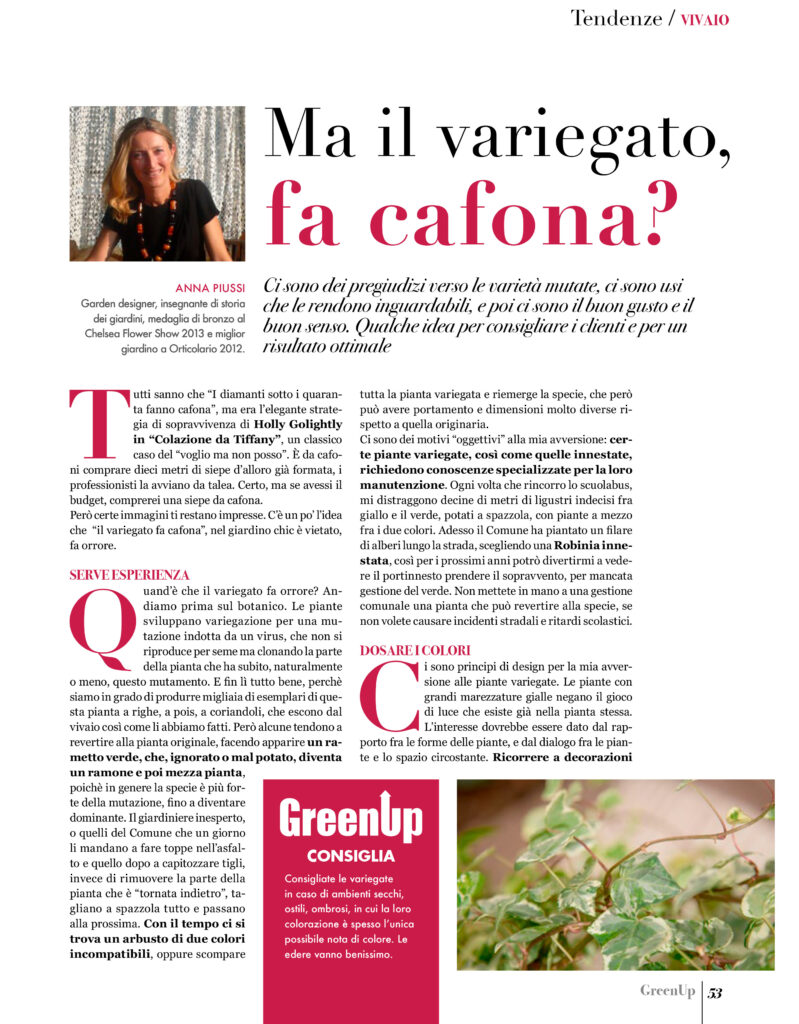
Holly Golightly in “Breakfast at Tiffany’s” famously said that diamonds before 40 are trashy. Of course it’s also a survival strategy, not to lust after something I can’t afford, but do I also have some prejudices against types of plants? Some would say variegated plants are anathema in a chic garden, but let’s look more closely at this controversial topic. Variegations are generally mutations induced by a virus, an abnormal reaction of the plant produces a ‘sport’ which can then be isolated, cloned and then mass produced. Variegations range from the elegant to the vile, but generally have one thing in common: they may revert to the original plant, as one small branch left unpruned will, over time, take over. So many cultivars with ‘Golden’ to their name will start as a yellow ball or hedge and then gradually turn half green, but unfortunately they are generally overused in municipal planting, where the unskilled gardener will not remove the errant sport in time, causing much annoyance at roundabouts. Personally I find yellow cultivars and variegations the worst, because they look unnatural and deny the play of light and shade already existent in foliage, unfortunately they abound in Aucube, Euonymus and Eleagnus which are unkillable, spottily thriving in the deepest dry shade since the Seventies.
However, its precisely for this capacity that they deserve a closer look. Dry shade is one of the most challenging conditions to plant in, because practically no flower will make it in there, but a variegated plant can bring interest and light even there. And this is it’s the perfect solution, provided you follow a few rules: don’t mix different colours, as they will clash, like white, cream and yellow. Avoid the yellow, and choose between white and cream. A number of plants with ‘marginata’ in their name have a simple line around the edges, it’s pretty and elegant, and variegation expands the interest of the irreplaceable Hedera and Vinca. There are many monocotyledons with a few stripes, like the priceless Carex Everesti, or the Dianella Tasmania variegata. Variegation per se is not trashy, just don’t overdo it and set it off as simply and cleanly as a jewel.